What Is an AI Qualified Lead (AIQL)?
By QuadSci Team
It's the question on every CFO's mind these days: what exactly is the ROI of AI for my business? Most AI sold to revenue teams does not have a straight line to revenue. Instead they sell efficiency and potential to impact things like win rate and revenue velocity. How? They read your communications and look for patterns. So AI providers price their solutions on usage, tokens or seats, and the return is left for the buyer to estimate. In fact, IBM found that only 25% of AI initiatives have delivered expected ROI.
But there's a better way. QuadSci uses machine learning and product telemetry to form the predictive foundation that identifies real revenue sitting in an install base. Then, through Growth AI, we deliver specific leads with precise information about the products to sell, how to sell and relevant peer examples. Every lead Growth AI delivers is tracked through to closed-won, and customers pay only for the leads that close.
It is the first predictive AI that identifies qualified leads to accelerate upsell and cross-sell velocity and guarantees the revenue generated from those leads. In short, it's the answer to the question you know the CFO will ask.
What is an AI Qualified Lead (AIQL)?
An AI Qualified Lead (AIQL) is an expansion opportunity inside an existing customer account. A predictive model identifies a lead based on how that customer behaves in your software, then qualifies it with the commercial evidence a seller needs to close it. It arrives before the customer asks to buy and before anyone on your team has put it in the pipeline.
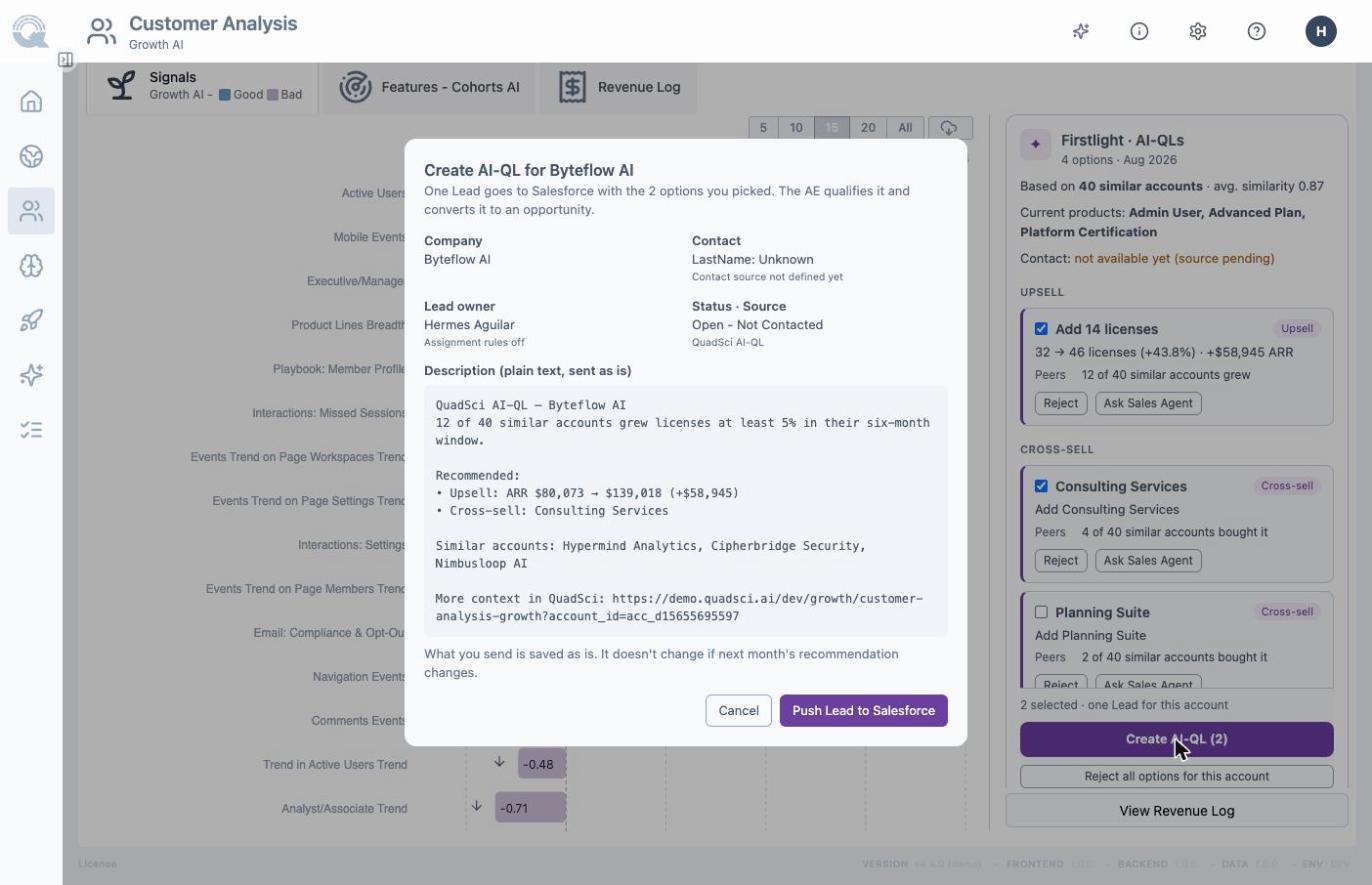
An AIQL is specific and enriched by context. For QuadSci, the lead comes with precise information about the product or volume to sell, the associated price and the contact to engage. Additionally, it names the peer customers who showed the same behavior, then bought the same thing, along with the notes, call transcripts and decks from those closed-won deals.
The seller decides what happens next. They accept the AIQL into pipeline or pass on it, and both answers go back into the model.
QuadSci Growth AI delivers AIQLs to sales teams. Revenue Intelligence Engine, the engine underneath, finds the accounts moving into growth. Growth AI turns each one into a lead a seller will want to work.
Why don't MQLs, SQLs and PQLs find expansion revenue?
Every lead definition in use today was built to win new logos. MQLs and SQLs score a prospect's interest: a form fill, a webinar, a demo request, a discovery call. That works when the buyer is a stranger and expressed interest is the only signal you have.
Your customers are not strangers. You can watch what they do in your product every day, and that behavior changes long before anyone asks for more seats or a new module. By the time expansion shows up as an inbound request or a renewal conversation, the customer has usually decided. Your seller is reacting to a decision instead of shaping it.
The PQL comes closest, because it reads product usage. But it was designed for product-led conversion, free to paid, and it usually fires on thresholds someone wrote by hand: a seat limit hit, a feature used five times. A threshold can tell you an account is active. It cannot tell you what that account is most likely to buy next, at what price, or which of your past deals to learn from.
The result is a gap most revenue teams never see. A healthy account with no open opportunity looks like a non-event, because pipeline tools inspect pipeline and there is none to inspect. QuadSci finds 15% of ARR is unpiped on average. That revenue is real, it is growing, and no existing lead definition was built to catch it.
How is an AIQL created?
An AIQL starts with a prediction and becomes a lead through context. Revenue Intelligence Engine classifies every account in your base into one of five growth classes, from High Growth to Churn, 9–18 months in advance of the churn or growth event. When Revenue Intelligence Engine classifies an account as High Growth or Medium Growth, it is correct 92% of the time.
A growth prediction alone is not a lead. Growth AI only considers an account when two things are true: it is in a growth class, and it has no open qualified pipeline. If your team is already working an opportunity there, the engine stays quiet. Every AIQL is net new by design.
Next comes the recommendation. Most people know the logic from Netflix or Amazon: customers who looked like you went on to choose this. Growth AI applies it to your install base. It finds the customers that looked the way this account looks today, six to nine months ago, with the same signals and entitlements. Then it shows what they bought. That tells the seller what to sell and at what price.
The peer customers are the part sellers remember. Every revenue leader wants more success stories, and no rep can hold every closed deal in their head. Growth AI keeps a memory of each expansion your customers have closed and finds the one most like the deal in front of you, with the notes, transcripts and decks that won it.
Context completes the lead. The Sales Agent reads opportunity notes, call transcripts, support history and CRM activity, recommends a contact, and turns the recommendation into a story a seller can repeat on a call. The AIQL lands in the Salesforce lead queue, linked to the full reasoning. The seller accepts or passes, and a passed lead is not served again.
An AIQL reaches a seller only when a growing account has no open pipeline
- Revenue Intelligence Engine predicts growth: High or Medium Growth class.
- Open qualified pipeline? If yes, no AIQL — the engine stays quiet.
- Nearest neighbor match sets the product, volume and price.
- The Sales Agent adds context: contact, notes and transcripts.
- The AIQL lands in Salesforce, linked to the full reasoning.
- The seller accepts or passes. A pass is written back and not re-served.
- Accepted AIQLs are worked to closed-won. Only closed-won AIQLs are billed.
An account with open pipeline never produces an AIQL, and a passed AIQL is never served again.
How is an AIQL different from an MQL, SQL or PQL?
The AIQL is the first lead definition built for the install base. The others measure a buyer's interest. An AIQL measures a customer's behavior against the history of what similar customers bought.
| Lead type | Agent-sourced lead | AIQL |
|---|---|---|
| Qualified by | An AI SDR or research agent | A predictive model trained on your history |
| Built on | Intent data, firmographics, web research | Product telemetry and commercial context |
| Shows up | When intent or fit is detected | Before the customer asks, on accounts with no open pipeline |
| Built for | New-logo outbound | Expansion in the install base |
| Arrives with | A contact and a drafted message | Product, volume, price, contact, peer customers and their closed-won deals |
What separates a good AIQL from a bad one?
Not all AIQLs are created equal. Any system can call its output a qualified lead. The test is whether a seller can check the reasoning and whether the vendor is accountable for the result. A good AIQL passes all five checks below.
| Check | A good AIQL | A weak lead |
|---|---|---|
| Predicted from behavior | Comes from how the customer uses your product, measured against what similar customers did next | Comes from keywords, intent spikes or a prompt with no outcome history |
| Evidenced | Names the peer customers who bought it and the deals a seller can study | Offers a score or summary with no reasoning a seller can check |
| Specific | States the product, volume, price and contact | Says the account looks healthy and suggests reaching out |
| Net new | Only fires on accounts with no open qualified pipeline | Duplicates work already in the CRM |
| Accountable | Is tracked from accept to closed-won, and the vendor is paid on closed-won | Is counted and priced by how many were produced |
Why does QuadSci only get paid when an AIQL closes?
Because the AIQL is the unit QuadSci is willing to be measured on. With Growth AI, you pay for AIQLs that close-won. You do not pay for the ones that close-lost, and you do not pay for the ones your team passes on. Your incentive is to close the deals. Ours is to make sure they are worth closing.
Outcome pricing only works if both sides can see the outcome. You can only price on a result you can predict and then attribute. The sales outcome performance tracker traces every AIQL from the moment it lands, to accepted, to closed-won. It also shows which AIQLs are still active and where new ones are forming for the quarters ahead. Your team audits our impact with the same instrument we use to settle the bill.
That is also why the definition matters. A lead standard without a payment model behind it is a marketing claim. A lead standard you are billed against has to hold up in a forecast review and at renewal.
How should a revenue team run AIQLs?
Treat the AIQL as its own pipeline source, owned by the seller on the account and measured by RevOps. Boards already ask for pipeline by source. Expansion from the install base deserves its own line next to marketing-sourced and SDR-sourced, instead of disappearing into "AM-sourced."
Routing is simple because the AIQL arrives where sellers already work. It lands in the Salesforce lead queue for the account owner, linked to the full recommendation. The volume is deliberately small, so a seller can work every lead they receive instead of learning to ignore the queue.
The accept-or-pass decision is where the team teaches the model. A pass is useful data, and the same lead will not come back next cycle. Set an expectation that every AIQL gets a decision within a defined window, so the queue stays current.
RevOps can run the program on a short list of measures:
- AIQL acceptance rate, by seller and by segment
- Time from AIQL to qualified opportunity
- AIQL-to-closed-won conversion and average deal size
- Closed-won ARR from AIQLs as a share of total expansion
- Unpiped ARR remaining in growth-class accounts
AIQL FAQ
What does AIQL stand for?
AIQL stands for AI Qualified Lead: an expansion opportunity in an existing customer account, found by a predictive model from product behavior and qualified with the commercial context a seller needs to close it.
Who receives AIQLs?
Account executives and account managers who own expansion in named accounts. QuadSci Growth AI is sold to the CRO and delivers AIQLs into the seller's Salesforce lead queue.
How is an AIQL different from a product qualified lead (PQL)?
A PQL fires when usage crosses a threshold someone set by hand, and it was built for free-to-paid conversion. An AIQL is predicted from the history of what similar customers bought, and it names the product, volume, price, contact and peer customers behind the recommendation.
Can an AIQL appear on an account that already has an open opportunity?
No. Growth AI only generates AIQLs for growth-class accounts with no open qualified pipeline, so every AIQL is net new.
How early does an AIQL arrive?
The moment an account moves into growth. Revenue Intelligence Engine identifies churn and growth events 9–18 months in advance, so AIQLs typically surface well before a renewal conversation or an inbound request.
How accurate are the predictions behind an AIQL?
When Revenue Intelligence Engine classifies an account as High Growth or Medium Growth, it is correct 92% of the time.
Does QuadSci use AIQLs for retention?
No. AIQLs are for expansion. QuadSci Engage AI covers retention and delivers recommended actions for at-risk accounts, not leads.
What does a company pay for AIQLs?
Only for AIQLs that close-won. AIQLs that close-lost or that sellers pass on are not billed.
See Growth AI in Action
Discover how Growth AI turns growth predictions into qualified leads your sellers can close, and you only pay when they do.