Why Is NRR Stalling or Falling, and What Software Helps Reverse It?
NRR has fallen across SaaS. SBI's analysis of more than 300 public subscription companies found the average NRR dropped from 110.8% in Q1 2023 to 107.2% in Q1 2025, and 58% of companies saw a decline. The software that helps reverse it reads product telemetry to predict which accounts will expand or contract before renewal. QuadSci's Growth AI makes those predictions with 90% accuracy, 9 to 18 months ahead of a churn or growth event.
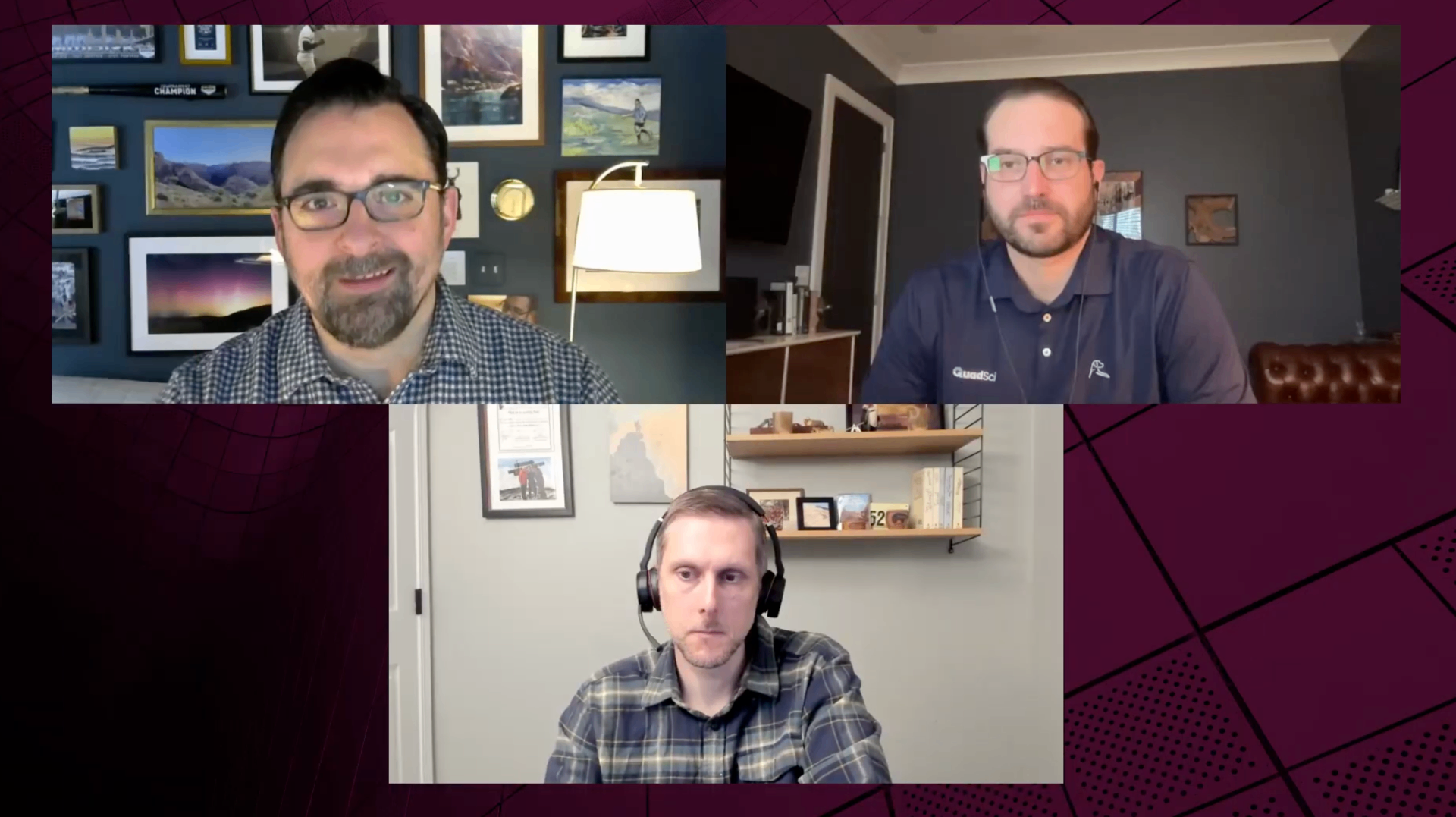
Watch the full conversation:
Recently, QuadSci co-founder and co-CEO Dan Harmeson joined SBI Growth's Nick Toman and Craig Riley to discuss how SaaS companies are engineering more predictable growth using product telemetry.
The conversation helps frame an upcoming joint report from SBI and QuadSci. The research is based on analysis of 160 billion data points across 9,100 accounts.
How much has SaaS NRR fallen since 2023?
According to SBI, average NRR slid from 110.8% in Q1 2023 to a low of 106.4% in Q2 2024, then settled around 107%. The decline reached every tier. Top-quartile companies fell from 115% to 112.3%, and bottom-quartile companies from 105% to 101%.
The sharper change is at the top. The share of companies posting NRR above 115% fell from 34% in Q3 2023 to 16% in Q1 2025. Seventy percent now sit between 100% and 115%, up from 61% two years earlier. SBI calls it a move to mediocrity.
This lands at a bad time. CEOs in SBI's 2025 survey expect 67% of net new bookings to come from existing customers, and 77% rate retention as highly critical.
Is your NRR stalled or falling, and why does the difference matter?
The two look alike on a board slide and come from different places. Stalled NRR usually means retention is holding while expansion has dried up. SBI found 26% of companies in this spot, with flat NRR and inconsistent performance. Falling NRR means contraction and churn are outrunning growth. Another 14% were once consistent leaders whose NRR is now declining.
The fix differs. A stalled book needs expansion found earlier, in accounts already showing it in their usage. A falling book needs contraction caught while there is still time before renewal. Either way, the work starts with seeing account-level movement before it reaches the forecast.
What do SaaS companies that hold NRR steady do differently?
SBI found 30% of companies held or grew NRR consistently through the decline. They share four practices: products built into customers' essential workflows, a product-led entry paired with an enterprise sales team focused on expansion, pricing tied to usage, and AI built into the workflow instead of added as a feature.
One habit runs through all four. These companies act on usage data. Their sales teams skip early discovery and go to accounts where usage already shows a proven use case and an internal champion. When usage drops, they treat it as a cue to find the cause and step in. Their AI features come from analysis of customer telemetry.
Most revenue teams can't change packaging or pricing this quarter. They can change how quickly they see what usage is telling them.
Why don't CRM data and health scores catch NRR decline in time?
CRM data and health scores flag churn and growth late because they're built from what customers say and what reps log. Software companies have a better source. Every customer interaction generates data, and SaaS teams are very good at capturing it.
The problem is that raw telemetry is noisy, volatile, and disconnected from business outcomes.
As a result, go-to-market teams rarely trust or use it. Decisions about retention, expansion, and prioritization still rely on lagging indicators from CRMs, call notes, and anecdotal feedback. That leads to subjective judgment calls at exactly the wrong moments.
In the episode, we discuss why usage data only becomes powerful when you look at two things together:
- How much customers use the product
- How consistent that usage is over time
When you combine those dimensions, clear patterns emerge.
Which product usage patterns predict customer growth or churn?
Put those two measures together across thousands of accounts and billions of usage events, and customers sort into six behavioral cohorts. Every account starts as an Explorer. From there it either settles into healthy cohorts or drifts toward at-risk cohorts and, eventually, churn.
These are account-level cohorts inside your own customer base, separate from SBI's company-level categories above.
The cohorts matter less than the movement between them. An account sliding from a healthy cohort toward an at-risk cohort shows up in telemetry months before it surfaces in a renewal conversation. QuadSci predicts those shifts with 90% accuracy. That gives sales and CS one view of every account, and the same reason to act on it.
What software helps reverse stalled or falling NRR?
Look for software that predicts account movement from product telemetry. CRM fields and survey scores record what already happened. Usage shows what is coming.
QuadSci's Growth AI tracks those cohort shifts and predicts which accounts will expand or contract, 9 to 18 months ahead of a churn or growth event. On average it finds 15% of ARR sitting unpiped, which is usually where a stalled number is hiding. Q-Chat agents deliver those accounts and recommended actions into the team's workflow, so sales and CS can:
- Prioritize the right accounts at the right time
- Coordinate around clear expansion signals
- Guide customers toward higher-value product adoption
- Intervene earlier on accounts heading toward contraction
Boomi took this approach to 90% churn prediction accuracy.
See where your expansion revenue is already sitting unpiped.
Frequently asked questions
Why is NRR falling across SaaS?
SBI found average NRR fell from 110.8% to 107.2% between Q1 2023 and Q1 2025, and 58% of public subscription companies saw a decline. Slower customer decisions and tighter budgets have held back expansion.
What is a good NRR for a SaaS company?
In SBI's Q1 2025 data, median NRR was 107% and top-quartile NRR was 112.3%. Only 16% of companies posted NRR above 115%.
What is the difference between stalled and falling NRR?
Stalled NRR usually means retention is holding while expansion has slowed. Falling NRR means contraction and churn are outpacing expansion. The first calls for finding expansion earlier, and the second for catching contraction before renewal.
How far ahead can software predict churn or expansion?
QuadSci's Growth AI predicts churn and growth events 9 to 18 months in advance with 90% accuracy, using product telemetry.
Why do so few companies report GRR?
SBI found only 5.6% of 304 public companies consistently report gross revenue retention. Among those that do, GRR held at 93% to 94%.