QuadSci Release 3.0: GTM Agents that know what's coming, powered by the world's most predictive customer intelligence AI
The AI wave was supposed to fix growth for B2B software. It hasn't. For most B2B software companies past $100M in ARR, AI hasn't moved the number that decides everything: net revenue retention.
Agents made revenue teams faster, but speed hasn't shown up in retention or quota attainment, because none of those tools ever learned how your customers actually use your product, or how that usage ties to revenue. And in B2B software, that gap is existential: 95% of revenue comes from customers you already have, and a one-to-two point slip in gross retention can't be backfilled with new pipeline inside a fiscal year.
So the question leadership is asking is more difficult to answer. It's no longer "are we using AI?" but "which AI investment actually moved revenue?"
The straightest line to revenue movement is AI that protects and grows that existing customer base by knowing which accounts are at risk, which are primed to grow, and what to do about it, from signals your team can trust and act on. That is the gap we built QuadSci to close, and Release 3 is a lead forward.
QuadSci is the only AI that synthesizes how customers actually use your product via your product telemetry with GTM actions, support patterns, and now the external events unfolding inside your customers' businesses. It turns that behavioral truth into intelligence delivered conversationally in our app, via MCP or in the tools revenue teams already use, early enough to change the outcome.
We always say "Telemetry is truth". Release 3 is a massive leap in what you do with it.
What's New
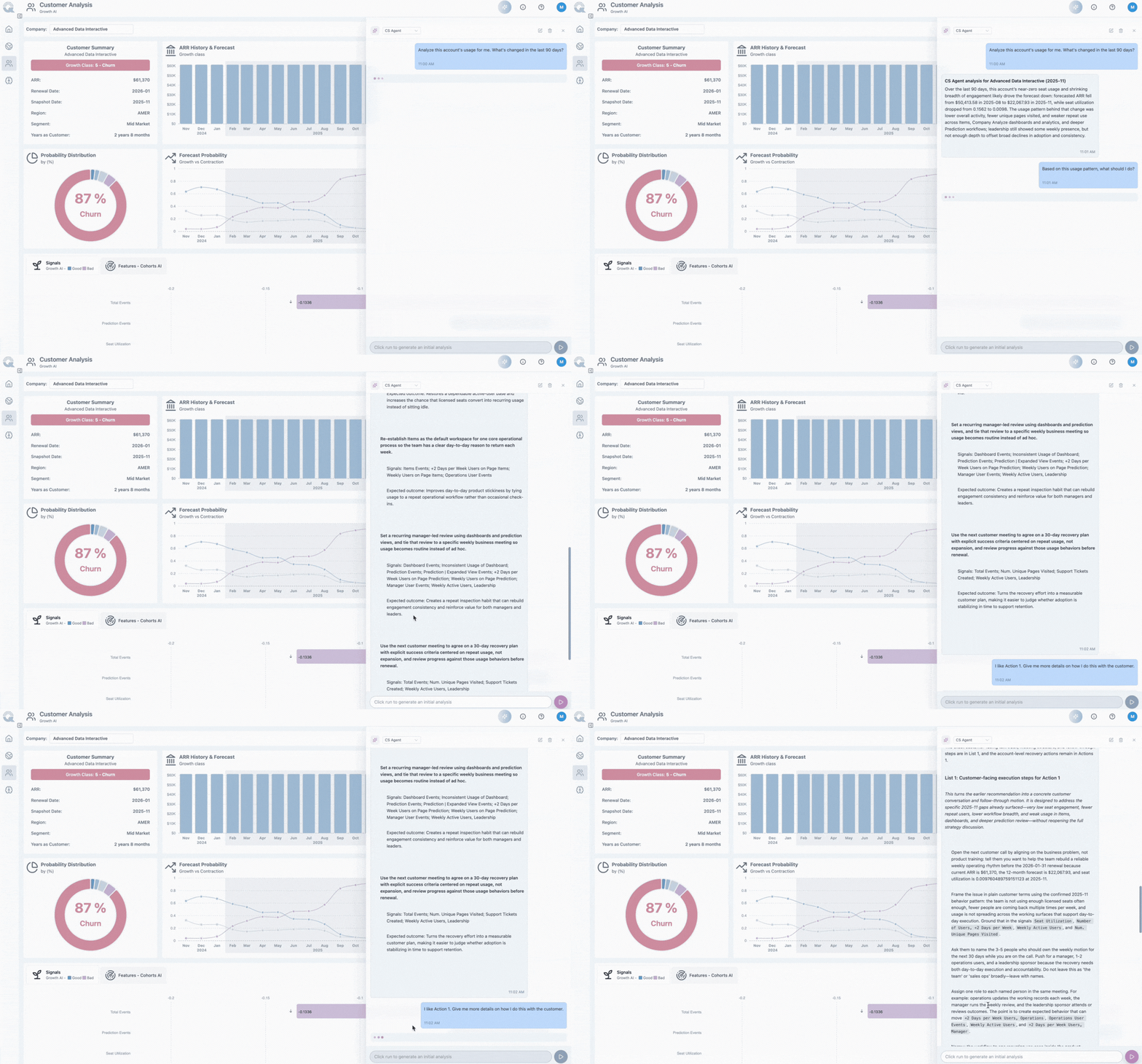
Q-Chat is now fully conversational. Revenue teams can ask direct questions in natural language within QuadSci to unlock the full potential of our predictive power and prescriptive signals to receive telemetry-grounded answers. These insights can then be made available inside Salesforce, Gainsight, Clari, Salesloft, Gong, and Slack and answer questions like:
- Why is this customer trending toward expansion?
- Which accounts are beginning to show risk?
- What should the account team focus on this week?
- What are the ideal expansion offers for your customers that are not in pipeline?
Every answer draws on the richest customer intelligence available to a software company: how your customers are actually using your products. Q-Chat reasons across what customers do on your platform, what they have been saying about their experience, and the external forces shaping their decisions. It does not drive decisions on generic rules, and it doesn't guess. The agents understand the signals that matter from customer usage, experience and external environment.
Seeing the Full Customer
Product telemetry tells you what customers do. It is objective, continuous, and free of the bias that shapes every human interaction. But it does not tell you what customers think, what they expected when they bought, or what pressures outside your product are quietly shaping how they make decisions.
Growth AI 3.0 layers two additional signal sources on top of the behavioral foundation. The first is conversational intelligence: what customers said in past sales cycles, the expectations that were set, how their perception of value has evolved, and what they are saying now. Platforms like Gong, Clari Copilot, and Gainsight Staircase bring this layer into the system. The second is market signal: leadership changes, acquisitions, funding rounds, financial pressure in the markets customers operate in.
The combination matters because each layer corrects for the others. Telemetry is objective but silent on context. Conversation is rich but filtered through what people choose to say. Market signal explains forces that neither layer can see on its own. Together they produce a view of each customer that is more complete and more honest than any single source provides.
That view, delivered with enough lead time to act on it, is what changes how revenue teams operate.
The World's Most Customer Behavior Aware Agents
We've also launched our QuadSci MCP Server. An AI agent is only as good as the signal it reasons on, and most revenue agents today run on the same thin 20% that health scores always have: CRM fields, conversation logs, and siloed signals scattered across GTM tooling.
These agent setups don't inherently understand what is important. QuadSci's MCP Server changes what agents can see, exposing the behavioral intelligence only QuadSci produces as a native, queryable layer inside any agentic workflow. Not a report exported after the fact, but a predictive, telemetry-grounded signal available at the moment of decision.
For GTM orgs building on Salesforce Agentforce and Microsoft Copilot to Bedrock, LangGraph, CrewAI, and fully custom agents on the OpenAI and Anthropic SDKs — any MCP-compatible stack — QuadSci's MCP empowers the data layer that makes any agent accurate, prescriptive and product-aware. QuadSci is the only platform that can produce the signal base that creates this experience and reasoning capability. This is the difference between an agent that summarizes what your team already logged and one that reasons on what your customers are actually doing. No other platform can produce this signal.
From Reactive to Strategic
Most revenue teams are not losing customers because they lack data. They are losing them because the signal arrives too late to do anything meaningful with it. By the time risk surfaces in a health score or a CRM flag, the decision is frequently already forming on the customer's side.
When you have a complete view of an account a year or more in advance, the nature of the engagement changes entirely. You are not managing a transaction. You are shaping a relationship with full knowledge of what the customer is experiencing, what they believe about the value they are realizing, and what outside pressures they are navigating. That is a different conversation, and it produces different outcomes.
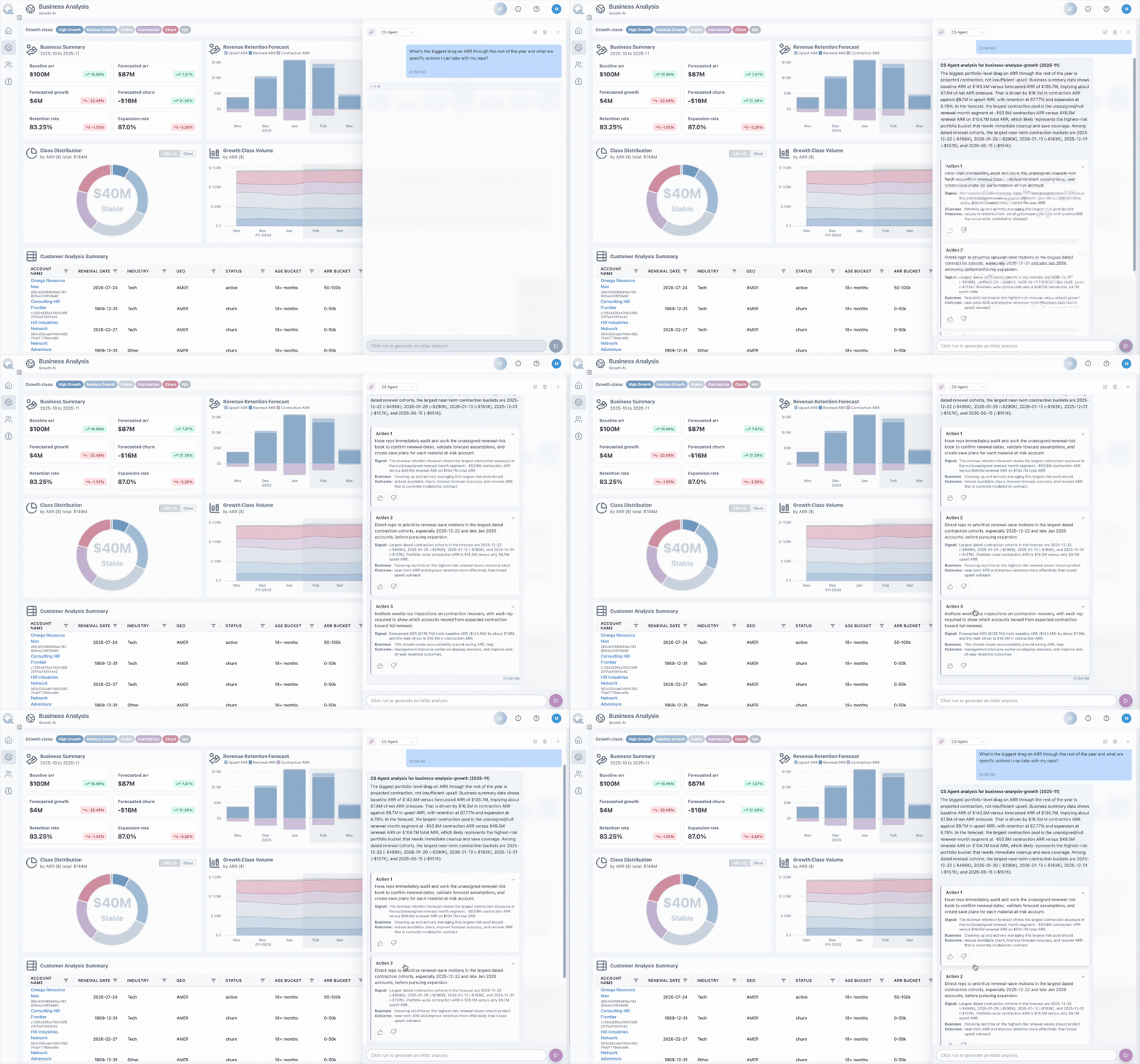
For the people closest to customers, that means starting every week knowing which accounts matter most, why they matter, and what actions are most likely to change the outcome. Not a dashboard to decipher. A clear view of where to focus and what to do. For leaders, it means an organizational view of revenue grounded in actual customer behavior, with the evidence to direct teams toward the work that protects revenue and accelerates growth.
The same intelligence that reveals churn risk reveals expansion opportunity. Accounts that are deepening their product usage, expanding into new workflows, or showing the behavioral patterns that precede growth are visible in the same signal layer. For a CSM or an AE, that means protecting revenue and growing it from the same view of the customer. For a team leader, it means the ability to direct resources strategically, call quarters with confidence, and deliver for the business rather than explain what happened after the fact.
What This Makes Possible
B2B software revenue teams have operated the same way for a long time. You manage a territory. You respond to signals. You prioritize based on what is urgent. You fight fires at the end of quarters and hope the board presentation reflects what you believe.
AI changes that model, but only if the intelligence feeding it is grounded in something real. Most systems are still reasoning from what teams have logged, what reps have entered, what customers have chosen to say. That is a thin and noisy foundation for the kind of decisions that determine whether a business grows.
We built QuadSci because we believed revenue teams deserved better intelligence. Today, we're proud to say we're moving closer to that goal. The intelligence in QuadSci is grounded in the behavioral truth of how customers use software, enriched with what they've said and the external pressures they are under. All delivered conversationally, in the tools revenue teams already use, with enough lead time to change outcomes.
This past year the team shipped conversational Q-Chat, rebuilt the experience end to end, expanded the integration landscape, and completed SOC 2 compliance, all while pushing model accuracy further. No two QuadSci deployments look alike, and that is the point. We unlock performance from each customer's complexity.
Want to learn more? Drop us a line.