What Is Growth AI and How Does It Work?
By QuadSci Team
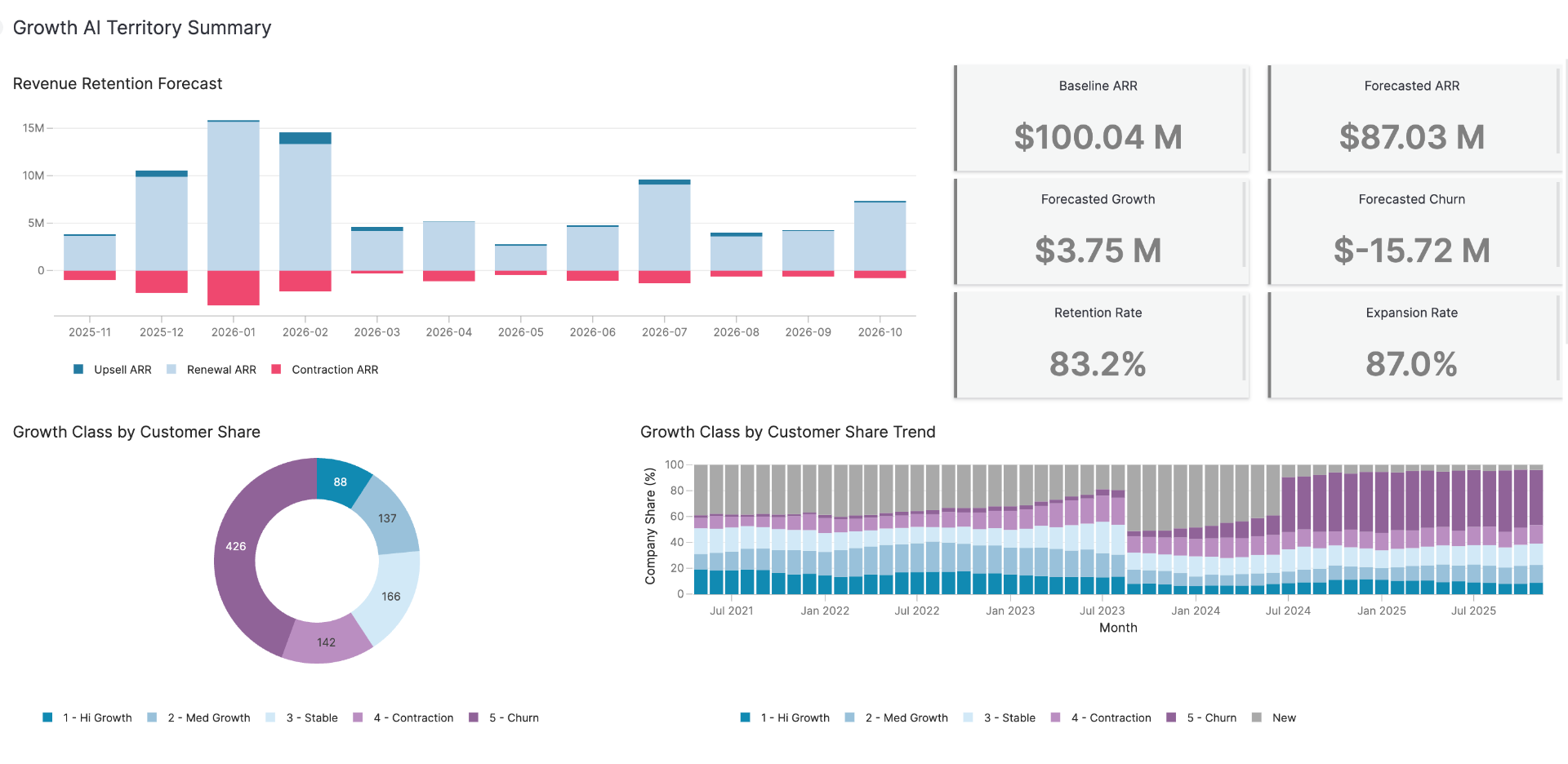
Growth AI is QuadSci's system for predicting customer revenue using supervised machine learning.
While Cohorts AI provides visibility into how customers behave, Growth AI predicts what that behavior is likely to produce in revenue terms. It is designed for go-to-market teams that need to prioritize accounts, allocate resources, and act with confidence, 9 to 18 months before a churn or growth event occurs.
Most GTM systems rely on manually defined rules based on account age, ARR size, or segment. These rules are intuitive but difficult to validate and often degrade as customer behavior and market conditions change.
Growth AI replaces these rules with predictions learned directly from real customer behavior.
How Growth AI Works
Growth AI begins with customer telemetry and interaction data. This includes product usage, engagement patterns, CRM activity, and service signals.
The system analyzes historical customer behavior alongside the revenue outcomes that followed. Instead of relying on assumptions about what should matter, it learns which behaviors actually led to expansion, contraction, or churn, trained across 15 trillion telemetry events.
These learned patterns are used to generate predictions tied directly to ARR. As customer behavior changes, predictions update automatically, creating a continuously refreshed, forward-looking view of revenue, with 90% predictive accuracy for both churn and growth.
Growth AI is designed to be explainable. Teams can see not only what the system predicts, but which behaviors are driving those predictions.
The Five Growth Classifications
Growth AI doesn't just flag risk. It classifies every account into one of five outcome categories, based on how its behavior has historically translated into revenue across comparable accounts:
- High Growth: behavior reflects strong, expanding value realization
- Medium Growth: usage supports incremental expansion
- Stable: adoption sustains the relationship without deepening it
- Contraction: behavioral signals indicate declining value
- Churn: patterns align with full disengagement
This is not a snapshot. Classification reflects how an account is trending relative to patterns observed across similar customers, which lets the model surface change earlier than a static health score ever could. An account can move between classes over time, and that movement is itself a signal worth watching.
Alongside classification, Growth AI produces forward-looking ARR forecasts at both the account and aggregate level, so leadership sees not just where revenue sits today but where it's likely to move over the next several quarters, and why.
Business Analysis
Business Analysis is the portfolio-level surface for Growth AI. It rolls up an entire book of business into one view: baseline, upsell, renewal, and contraction ARR, expansion and retention rates, a revenue retention forecast by month, and the full distribution of accounts across the five growth classes.
Underneath the summary sits the full account list. Every account is broken out with renewal date, status, ARR, forecast ARR, class percentage, and growth class, so the roll-up is never disconnected from the individual accounts driving it.
For RevOps leaders and CS or sales managers, Business Analysis answers a different question than any single account can. It's not "is this account okay," it's "where should the team's finite time go this week, this quarter, this half." And the framing runs forward, not backward: the forecast tracks upsell and renewal ARR alongside contraction, because the story Growth AI tells about a book of business is as much about where expansion is forming as where risk is.
Account View
Account View is the longitudinal, single-account surface inside Customer Analysis. It shows how one customer's behavior has evolved over time, which growth class it currently sits in, and which specific signals are driving that classification.
This is the surface built for CSMs and AEs. Instead of a health score with no explanation attached, Account View shows the behavioral trail: what usage looked like months ago versus now, where it diverges from the pattern of similar accounts that expanded or churned, and what to focus on this week to change the outcome. It turns a classification into a next conversation.
From Prediction to Action with Q-Chat
Q-Chat is how Growth AI becomes actionable. It runs as a set of purpose-built agents, a CS Agent, for example, available directly alongside whatever screen a user is on, from the portfolio-level Business Analysis view down to a single account inside Customer Analysis.
Instead of just displaying a chart, teams can ask Q-Chat to explain what they're looking at, wherever they are. An agent can take a question like "please explain the Transition Percentages chart" and return an answer grounded in the actual cohorts and accounts behind it, not a generic gloss on what the chart type usually means. Ask the same kind of question from inside a single account's view, and the agent answers in that context instead, grounded in that account's own behavior.
More broadly, revenue teams ask direct, natural-language questions inside QuadSci and get telemetry-grounded answers, delivered in Salesforce, Gainsight, Clari, Salesloft, Gong, and Slack. Questions like:
- Why is this customer trending toward expansion?
- Which accounts are beginning to show risk?
- What should the account team focus on this week?
- What are the ideal expansion offers for customers not in pipeline?
Every answer draws on the same behavioral truth behind Business Analysis and Account View. Q-Chat doesn't run on generic rules and it doesn't guess. For managers, it surfaces where attention is needed across the book of business. For account teams, it connects behavior directly to the next step, wherever they're already looking.
Growth AI's intelligence also extends beyond the QuadSci app through the QuadSci MCP Server, which exposes it as a queryable layer inside any agentic workflow, including Salesforce Agentforce, Microsoft Copilot, Bedrock, LangGraph, CrewAI, and custom agents built on the OpenAI and Anthropic SDKs. Instead of a report exported after the fact, the same predictive, telemetry-grounded signal is available at the moment an agent is deciding what to do next.
How Growth AI Fits Into QuadSci
Cohorts AI, Growth AI, and Q-Chat are designed to work together, and Growth AI's predictions draw on more than product usage alone.
Cohorts AI identifies how customers behave by analyzing telemetry data. Growth AI takes that behavioral foundation and layers in two additional signal sources: conversational intelligence (what customers have said across sales cycles and support conversations, via tools like Gong, Clari Copilot, and Gainsight Staircase) and market signal (leadership changes, funding rounds, and financial pressure in a customer's own market). Together, these three sources produce a classification that's more complete than any single signal source alone, telemetry is objective but silent on context, conversation is rich but filtered through what people choose to say, and market signal explains forces neither layer sees on its own.
Q-Chat translates all of it into action, in the tools teams already use or through any MCP-compatible agent.
Together, they replace static reporting and manual interpretation with continuous prediction and guided execution.
See Growth AI in Action
Discover how Growth AI turns customer behavior into forward-looking revenue predictions your GTM teams can act on.